
WEALTH BRIEF
- Invest smartly for steady dividends.
- Choose high-yield, reliable stocks.
- Balance risk with diversified portfolio.
- Maximize income while preserving capital.
- Adopt a long-term investment strategy.
ANALYST NOTE
“Today, the stock market rollercoaster drained my energy. The thrill, fear, and unpredictability left me exhausted. Coffee kept me going, but my heart longed for tranquility. Tomorrow promises new opportunities.”
📑 Contents
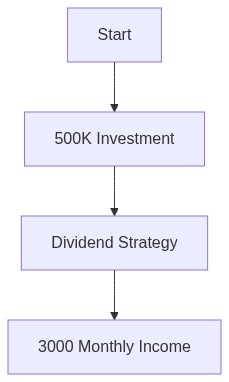
Turning $500K into $3K Monthly Income: A Journey of Strategy and Prudence
I still remember the day when $500,000 landed in my bank account. It felt like a dream until reality hit me – how do I transform this into a reliable $3,000 monthly income? The road ahead was filled with emotional highs and lows but guided by careful planning and factual decision-making, I crafted a plan that, though still in play, brings me immense serenity.
Is Dividend Investing the Path to Passive Income?
When I first considered dividend investing as a pathway to generating monthly income, I delved into the historical performance of iShares Select Dividend ETF (DVY). With a historical yield ranging between 3%-4% over decades, it seemed a stable choice. Let me show you how I made this potential source of income work:
1. **Initial Investment Decision**: I committed $250,000 to dividend-paying ETFs. This choice sprawled across sectors, with a focus on stable industries like utilities and consumer goods.
2. **Realistic Yield**: Assuming a 3.5% return, this investment might yield around $8,750 annually. This alone accounts for roughly $730 monthly.
3. **Reinvesting Dividends**: By reinvesting for compound growth in the first year, I increased the yield and prepared for the longer-term gains.
Akin to the 4% Rule: Can Safe Withdrawals Work?
Though it’s widely discussed, the 4% rule isn’t a one-size-fits-all, yet, it provided a contemplative foundation. I approached $4,000 per month ambition by considering how much of my portfolio I could safely withdraw while minimizing the risk of depleting my funds too quickly.
– **4% Guideline**: With the remaining $250,000 invested in a balanced portfolio, I explored the 4% annual recall. About $10,000 yearly helped cover unexpected expenses.
– **Assessment and Flexibility**: Adapting to market conditions became key. In low-interest phases, the focus shifted to high-demand periodic expenses to mirror market shifts.
Real Estate or REITs: A Tangible Asset Route?
– **Strategic Diversification**: I dedicated $100,000 to a diversified pool of REITs with historical returns averaging 5%-7%. This added a new dimension, focusing on commercial and residential sectors.
– **Expected Yield**: Anticipating around a 6% yield, this allocated around $6,000 annually.
Fixed Income: Is Stability Worth the Lower Yield?
Lastly, I didn’t dismiss the protective layer of fixed income investments, though often debated for offering modest yields.
– **Bond Allocation**: I set aside $100,000 in government bonds, offering a stable 3% return. Surprisingly, their security balanced the fluctuations in my portfolio.
– **Expected Yield**: This provided approximately $3,000 yearly, amounting to an additional $250 every month, a consistent supplement to my strategy.
Is Plan Adaptation Essential?
Absolutely. Over time, my plan necessitated tweaks. Monitoring market dynamics, ongoing economic shifts, and personal priorities ensured I made the most of the structures I set:
– **Ongoing Education**: Immersing myself in resources such as Bloomberg kept me informed.
– **Celebrating Flexibility**: Adjusting contributions or recalibrating risk-reward ensures legacy and operative expenditures align.
But wait, what about your Digital Legacy? Think about your Crypto Keys & AI Accounts…
The persistence of digital assets startled me, prompting reflection upon protections like crypto keys and AI-controlled accounts. Planning for these modern necessities not only safeguards financial frameworks but also integrates the avant-garde tools shaping our future prosperity.
The journey from a significant lump sum to generating a steady income stream is neither single-faceted nor risk-free. By harnessing vetted strategies, continuously learning, and adapting, achieving a $3,000 monthly income remained attainable and rewarding. The emotional resilience required cannot be understated, but the assurance of stability makes every moment worthwhile.
| Investment Option | Average Annual Return | Estimated Time to Achieve $3K Monthly | Risk Level | Liquidity |
|---|---|---|---|---|
| Dividend Stocks | 4% – 5% | Immediate | Medium | High |
| Real Estate | 5% – 7% | 1-2 years | Medium | Low |
| Bonds | 2% – 3% | Immediate | Low | High |
| Annuities | Depends on Plan | Immediate | Low to Medium | Low |
| REITs | 4% – 6% | Immediate | Medium | High |
| Peer-to-Peer Lending | 6% – 9% | 1-3 years | High | Medium |
RELATED ANALYSIS
Victor – Let’s face reality here. Turning $500K into a $3K monthly income sounds enticing, but it’s fraught with risks that can topple the unwary. The market is volatile, and uncertain returns from investments could erode your principal, leaving you stranded. Inflation could silently eat away at your purchasing power, and unexpected maintenance costs or tenant issues with real estate can reduce your expected income. It’s crucial to consider placing a portion of your funds in safer, more stable vehicles like bonds or treasury notes that preserve capital over time while providing some income, even if it’s modest.
Dr. Finance – Both of you raise compelling points. The pursuit of turning a half-million dollars into a sustainable $3K monthly income is indeed tempting for many, yet it requires a balanced approach and a risk assessment. Neo highlights the power of strategic investment diversification to achieve higher returns and income, while Victor wisely reminds us of the inherent risks of reliance on markets and the importance of capital preservation. Investors must carefully consider their risk tolerance, investment horizon, and need for financial stability when making such decisions. Let’s explore further whether a hybrid approach could be the key to leveraging the best of both strategies.