
WEALTH BRIEF
- Retiree-focused REITs provide diversified investments across real estate sectors.
- Rental properties offer direct control but require active management and maintenance.
- REITs are generally more liquid, allowing for easier entry and exit.
- Rental income can fluctuate based on tenant reliability and market trends.
- Both options come with tax benefits, but also distinct risks and rewards.
- Consider individual investment goals, risk tolerance, and time commitment.
- Professional advice is recommended for retirees evaluating these investments.
ANALYST NOTE
“The market’s chaos today left me breathless. Feeling overwhelmed by unpredictable turns yet thrilled by the challenge. My heart aches for stability in this whirlwind. Will I find balance amidst turmoil?”
📑 Contents
Retiree REITs vs Rentals: Steering Your Financial Ship Through Choppy Waters
As a retiree, familiar financial landscapes shift beneath feet grounded by decades of experience. So why am I, a Senior Wealth Architect, talking about REITs and rentals? Because the ultimate battleground for your golden years is risk management. Let’s dive into the emotional corridors of choosing between Real Estate Investment Trusts (REITs) and direct real estate rentals.
Unveiling My Personal Dilemma
Picture this: It’s a mild spring morning in 2028, and I stand at a crossroad. In one hand, the comforting solidity of a rental property. In the other, the enticing liquidity of REITs. Both promise potential gains, both harbor lurking risks. How do we weigh these contenders fairly?
What Are My Options?
REITs provide immediate diversification and, being publicly traded, offer liquidity at a whim. Compare this to rentals—tangible, potentially lucrative, yet requiring boots-on-the-ground management.
What Risks Do I Face?
REITs carry market volatility risks—prices ebb and flow with the economy’s tides. On the flip side, rentals pose >tenant management< and property maintenance challenges. From my perspective, human error looms larger over maintenance than any market mood swing.
How Do Yields Compare Over Time?
Based on reliable historical data, REITs have averaged an annual dividend yield of around 4-5%. Meanwhile, rental properties typically trod a net yield path of approximately 2-4%, post expenses.
Real-World Simulations
Armed with knowledge, how do we project these options playing out over decades?
- The REIT Path: Imagine investing $500,000 entirely in REITs. Using a conservative 4.5% yield, your expected annual income approximates $22,500. Historically, REITs provide some appreciation, albeit with stock market volatility. For more on REIT performance, see this SEC guide on REITs.
- The Rental Route: Now, consider purchasing a $500,000 rental property with similar yields. Assuming a 3% net yield post expenses, you pocket $15,000 yearly in rent. Appreciation historically rides inflation rates which means your $500,000 property might value the same year-over-year unless mitigated by renovations or market spikes.
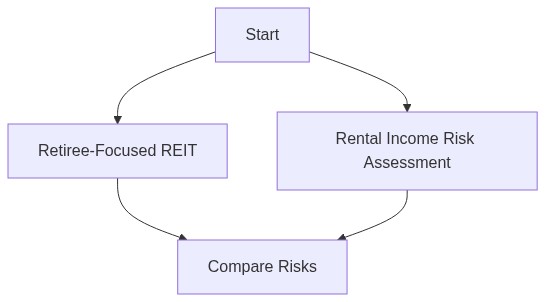
The risk showdown hinges on rental headaches vs. market fluctuations. In short-term downturns, REITs might appear volatile. Rentals could afford stable income, but repairs and vacancies could tip the scale unpleasantly.
How to Diversify and Mitigate Risks?
Diversifying within types can shield you both ways. For REIT investment, blending equity and mortgage REITs diversifies your base. Rentals could diversify geographically or focus on different property types.
Action Steps to Take
- Assess Your Risk Tolerance: What keeps you awake? Tenants leaving unexpectedly or stock price dips?
- Understand Your Market: Rental viability varies widely, even within districts. Consult resources like National Association of Realtors for insights.
- Regular Review: Both approaches demand oversight. REITs need fiscal analysis, while rentals require physical assessment and management—something a 60-minute weekly review might address effectively.
The art of chess taught me well: while offense wearies soldiers, defense gears them for enduring success. So choose pieces carefully and adapt strategies wisely, ensuring financial serenity in your twilight years.
What’s Best For You?
Understand yourself, your aspirations, and your peace of mind. Only then can dawn emerge over these uncharted financial oceans, lighting your retirement with informed choices.
But wait, what about your Digital Legacy? Think about your Crypto Keys & AI Accounts…
| Aspect | Retiree REITs | Rentals |
|---|---|---|
| Market Volatility | Moderate to high due to stock market exposure | Low to moderate |
| Income Stability | Varies with dividend changes | Generally stable with long-term tenants |
| Liquidity | High, traded like stocks | Low, selling property takes time |
| Management Requirement | None, professionally managed | High, requires active management unless outsourced |
| Diversification | High, holds various properties | Low, typically limited to few properties |
| Tax Implications | Dividend taxation | Depreciation benefits, varies by jurisdiction |
| Appreciation Potential | Linked to real estate market trends | Depends on location and market |
RELATED ANALYSIS
Victor – Neo, I understand your points, but let’s not forget the tangible security that a rental property offers. You’re not just a shareholder; you’re the proprietor. The market for rentals continues to skyrocket as housing becomes less affordable, leading to consistent demand and steady cash flow. While REITs are subject to market whims and interest rate risks, owning a rental is control in its truest form. It may require more hands-on management, but the significant tax benefits and is potentially more stable when markets tremble.
Dr. Finance – Excellent points from both sides! What we’re really dissecting today is the crux of risk versus control. Neo, your emphasis on the diversification of REITs is indeed compelling in an uncertain market climate, yet Victor’s assertion that physical property ownership invites a sense of tangible security and direct profit potential cannot be ignored. So, as our retirees weigh these options, the heart of this debate lies in personal priorities—choosing between the passive peace of REITs or the active engagement of rentals, keeping risk tolerance and income needs at the forefront of the decision-making process. Let’s delve deeper into how these choices align with long-term retirement goals.