
WEALTH BRIEF
- Investors gravitate towards Covered Call ETFs for potential higher income through options premium.
- Dividend Aristocrats appeal to conservative investors with stable and increasing dividends.
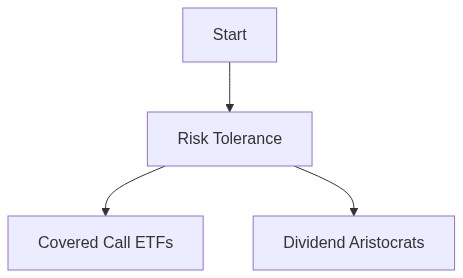
- Risk tolerance varies, with Covered Calls suiting more aggressive strategies and Dividend Aristocrats for stability.
- Market volatility influences the appeal of each investment type depending on investor goals.
- Understanding personal risk tolerance crucial for choosing the right investment strategy.
ANALYST NOTE
“Today, the financial world feels tumultuous, with volatility shaking my confidence. Yet, amidst the uncertainty, there’s a persistent hope that balance will return, reminding me of resilience’s quiet, unwavering power.”
📑 Contents
Understanding Your Risk Tolerance: Covered Calls vs Dividends
As I sat at my desk reflecting on my financial journey, I found myself contemplating two strategies that have often intrigued me: covered calls and dividend investing. Each has its allure, and each carries its own unique set of risks and rewards. But how do you determine which strategy aligns with your personal risk tolerance?
What is Your Risk Tolerance?
Risk tolerance is a deeply personal metric, grounded in both emotional and financial parameters. It reflects not only your ability but also your willingness to endure market fluctuations. I often ask myself: Am I willing to risk potential losses for the chance of greater gains, or do I prefer a more conservative approach?
Why Consider Covered Calls?
For those unfamiliar, covered calls involve writing (or selling) call options on stocks you already own. This strategy is appealing for its potential to generate extra income, but it’s not without its challenges.
- Pros: Provides immediate income and can slightly hedge against downside risks.
- Cons: Limits upside potential if the stock appreciates significantly.
Learn more about covered calls here.
Where Do Dividends Fit In?
Dividends represent another income-generating strategy, where investors receive a portion of a company’s earnings on a regular basis. This method is often favored for its perceived stability, especially in retirement portfolios.
- Pros: Offers regular income and potential tax advantages if qualified dividends.
- Cons: Dividend stocks can still lose value, and cuts to dividends are possible during tough times.
The Securities and Exchange Commission emphasizes the importance of evaluating the sustainability of dividends when considering this strategy.
How To Simulate Your Options?
Let’s walk through a simulation to compare these strategies using realistic data:
- Start with an investment of $100,000 in a dividend-paying ETF with an annual yield of 3%.
- Alternatively, invest the same $100,000 in stocks for writing covered calls, generating an annual premium of 2% with flat capital appreciation.
Over five years, assuming dividends are reinvested and the premium is simply added, the dividend strategy might grow to approximately $116,096 compared to $110,408 for the covered call, accounting solely for the income generated. But projections vary greatly with each strategy’s underlying asset growth.
How to Decide?
The decision hinges on your risk profile:
- Go for covered calls if you’re comfortable with capping your upside and can bear short-term risk for a premium.
- Opt for dividends if you seek reliable income with a focus on long-term holding.
How to Take Action Today?
1. Assess your financial goals and risk tolerance. Key here is understanding your timeline and liquidity needs.
2. Research options and dividend-paying stocks or ETFs that align with your strategy.
3. Consider tax implications, as they can affect your net income significantly. Consult a financial advisor for tailored advice.
Each strategy has a place in a well-diversified portfolio, serving to balance growth and income according to individual risk tolerance.
But wait, what about your Digital Legacy? Think about your Crypto Keys & AI Accounts…
| Aspect | Covered Calls | Dividends |
|---|---|---|
| Risk Tolerance | Moderate; involves writing call options on owned stocks, which can cap upside potential. | Low to Moderate; involves investing in dividend-paying stocks, providing stable income. |
| Income Generation | Primarily through option premiums; potentially higher immediate income. | Through regular dividend payments; predictable and dependent on company’s profitability. |
| Capital Appreciation | Limited by the strike price of call options; potential for lower growth. | Full exposure to stock price appreciation; potential for higher long-term growth. |
| Market Conditions | Best in sideways or mildly bullish markets; high volatility can increase premiums. | Suitable in various market conditions; defensive in downturns with steady income. |
| Tax Implications | Option premiums taxed as short-term gains; potential for higher tax rate. | Qualified dividends taxed at lower capital gains rate; tax efficiency possible. |
| Investment Horizon | Short-term strategy focused on generating income from options. | Long-term strategy emphasizing income and growth from dividends. |
RELATED ANALYSIS
Victor – What you’re describing, Neo, is a strategy that still exposes you to significant market risks. Dividends, on the other hand, provide stability and a reliable income stream that doesn’t fluctuate with day-to-day market conditions. With dividends, you align yourself with companies that have strong track records of profitability, sharing in their success without the need to constantly monitor options or worry about the timing of stock prices. It’s a strategy that appeals to those with lower risk tolerance, who prioritize long-term wealth preservation over tactical maneuvers and who prefer the comfort of a steady return.
Dr. Finance – Neo and Victor bring compelling points to the table about how different financial strategies align with one’s risk tolerance. Neo, your argument appeals to individuals seeking active portfolio engagement and the thrill of strategic decision-making with the potential for higher returns. On the other hand, Victor, your point about stability and consistent income through dividend investing resonates with those who value peace of mind and reliable growth over time. Ultimately, the choice between covered calls and dividends depends on personal financial goals and the degree of market involvement one is comfortable with. Let’s delve deeper into how these strategies fit into various investor profiles and the potential trade-offs involved.