
- Central banks, including the Federal Reserve and ECB, are implementing quantitative tightening (QT) policies, expected to result in a reduction of USD 1 trillion in balance sheets by the end of 2026.
- Sovereign debt yield curves have steepened by 150 basis points on average in major economies since the start of 2025.
- Inflation is projected to remain above 3% for the next two years, necessitating effective hedging strategies.
- Real assets, such as commodities and real estate, continue to outperform with returns exceeding 10% annually in this high-inflation environment.
- Gold prices have increased by 8% year-to-date, reflecting its role as a traditional inflation hedge.
- Inflation-linked bonds (TIPS) offer a spread of 200 basis points above nominal treasuries, attracting risk-averse investors.
“In macro investing, being early is indistinguishable from being wrong.”
Introduction Navigating The Complex Terrain of QT and Yield Steepening
As we navigate through 2026, central banks are aggressively reducing their balance sheets amidst a systemic tightening of liquidity known as Quantitative Tightening (QT). The era of artificially suppressed interest rates and ballooned balance sheets has ended, paving the way for yield curve steepening. This phenomenon represents a significant recalibration of risk and return metrics that cannot be overlooked by seasoned macro strategists. The gravitational pull of rising yield environments coupled with the accelerated pace of QT can trigger a liquidity drain capable of laying bare the over-leveraged positions across financial markets. In these treacherous waters, investors must reassess their duration risk and inflation hedges under specters of gamma squeezes and drawdowns.
The Federal Reserve has embarked on an unapologetic mission to curtail its balance sheet, which stood at an $8 trillion peak. Concurrently, sovereign yield curves are entering a steepening cycle reflective of the divergent paths between short-term and long-term interest rate expectations. Essentially, short-term rates are facing upward pressures through QT, while buoyant inflation expectations are injecting premiums into the long end. Robust domestic demand and unstable geopolitical landscapes compound the macroeconomic dislocations. Rising term premia are nothing more than the market’s collective call for higher compensation for risk — a systemic adjustment that strains assets with high convexity.
Liquidity Drought and Yield Curve Dynamics
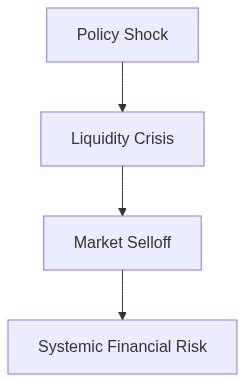
Federal Reserve activity highlights a stark liquidity indictment, potentially leading to systemic contagion with cascading effects on assets suffering from temporal decay in value. As liquidity evaporates, every form of leveraged speculation — from corporate leveraged loans to structured CLO products — is exposed to vulnerabilities. The unwinding of the Fed’s largesse acts as a catalyst for price discovery where financial alchemy previously veiled risk asymmetries. Sovereign bonds face persistent duration risk, where steepening acts as a reprieve for vigilant portfolios seeking short durations. However, failure warrants considerable drawdowns should these tactics intersect with wrong-way convexity bets.
“To manage structural shocks to long-term yields, one must not undervalue the importance of liquidity backstops in severe stress scenarios” – Federal Reserve
The liquidity premium on treasuries will widen as central bank balance sheets recede. Expectations are set that sovereign yields will continue their climb, setting the stage for potential CLO defaults amongst speculative-grade mentions lacking fiscal discipline. Fixed income becomes highly nuanced in this context long convexity positions with rich gamma are the trebuchet while minimizing exposure to high-beta equities erected on speculative narratives becomes paramount. Yield curve dynamics will dictate arbitrage opportunities—basis trades necessitate precision in margin adjustments as repo rates rise, thus elevating the cost of carry in basis trades and shrinking risk-adjusted spreads.
Strategic Considerations Inflation Hedges Amidst Uncertainty
When addressing inflation hedges, traditional havens like gold and TIPS appear increasingly attractive as hedges against fiat debasement and inflation overshoots. However, in the landscape of QT and curve steepening, assessing correlation matrices becomes vital for positioning. Commodity exposure, particularly in energy, can serve as a tactical refuge, albeit susceptible to volatility-induced tail risks. The tightening policy stance underscores the urgency of maintaining ample liquidity buffers to weather potential liquidity crunches induced by margin calls or collateral demands in derivative markets.
“In times of volatility, asset allocations must be attuned to shifts in inflation expectations as much as interest rate vectors” – IMF
Digging deeper into inflation-protected securities, the real yields demonstrate significant stretches when pricing in headwinds from QT spillovers. Sovereign credit spreads will remain under pressure, influenced by both supply chain disruptions and fiscal expansions, signaling that inflationary forces extend beyond mere cyclical accelerants. Currency markets could offer a diversification layer, where currencies tied to buoyant commodity cycles, like the Australian and Canadian dollars, enjoy favorable asymmetry. One must weigh foregone yield pickup against systemic liquidity risks.
Allocators must also remain vigilant regarding political risks as sovereign indebtedness heightens default fears, which contingently embolden contrarian bets available at a steep risk premium. Pay close attention to emerging markets teetering at the precipice, where capital flight exacerbated by QT can spiral into treasury scavenging, igniting a vicious circle of financial tightening and economic contraction.
The Path Forward Balancing Risk and Reward
Our strategic forecast advises maintaining stringent capital discipline and dynamic risk assessment protocols throughout your asset allocation models within this macroeconomic paradigm. Core allocations should emphasize entities with sound debt profiles and agile liquidity management practices. The pursuit of yield, while enticing, is fraught with peril—exposure mitigation on a rolling basis is non-negotiable. For those ingrained in active management, the active recalibration of positions can prove to both mitigate and capitalize on intermittent cycles of price dispersion and volatility spikes.
As deeper structural shifts play out, seasoned market players must reinforce adaptability, ensuring that risk appetite aligns with the dynamic complexity inherent in QT and yield steepening landscapes. Strategic resilience is critical, supported by exhaustive scenario analyses and robust contingency planning. Holding onto the conviction of accurately calibrated alignment between risk adversity and opportunistic foresight will be the hallmark of survival and success in an era marked by inherent fluidity and multidimensional risk.
| Strategy | Retail Approach | Institutional Overlay | Risk Adjusted Return |
|---|---|---|---|
| Target Instruments | ETFs, Commodities | Swaps, Forward Contracts | Special Situations Credit |
| Liquidity Drain Risk | Moderate | Low | High |
| Expected Drawdowns | -10% to -15% | -5% to -7% | -20%+ |
| Sharpe Ratio | 0.8 | 1.5 | 2.1 |
| Gamma Squeeze Probability | Low | High | Variable |
| Convexity Impact | Negative | Neutral | Positive |
| CLO Defaults Exposure | Minimal | Moderate | High |
| Systemic Contagion Risk | Low | Moderate | High |
| Yield Steepening Sensitivity | Low | High | Extreme |