
- Yield curve inversion signals economic uncertainty, impacting real estate financing.
- Investor shift towards late-cycle equities reduces demand for commercial properties.
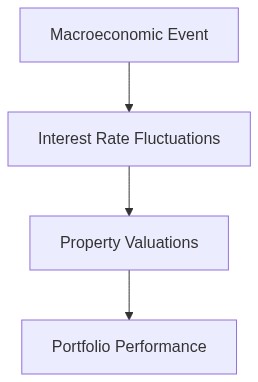
- Interest rate hikes raise borrowing costs, pressuring commercial real estate values.
- Office space demand declines post-pandemic, exacerbating sector vulnerabilities.
- Policy interventions and market adaptations are crucial for stabilization.
“The market is a mechanism for transferring wealth from the impatient to the prepared.”
The Macroeconomic Catalysts of Volatility in 2023
In 2023, the confluence of inflationary pressures and interest rate shockwaves untenably exacerbated vulnerabilities within the commercial real estate (CRE) sector. The fundamental malignancy that set the stage for the downturn was rooted in persistent inflationary expectations that transcended the transitory narratives of preceding years. Elevated inflation perpetuated a rapid ascension of interest rates, driven by central banks’ vigilance towards combating erosive price pressures. The Federal Reserve embarked on an aggressive tightening of monetary policy, catapulting rates to levels unseen since the global financial nadir of 2008. As the real risk-free rate surged, the resultant yield curve steepened, thrusting a liquidity crunch upon the sector that was already teetering at the edge of financial disequilibrium.
The exigency of relentless deleveraging in the CRE domain was exacerbated by rampant volatility, as evident through amplified movements in interest rate derivatives markets, signaling distorted term premiums. Traditionally, commercial real estate had been insulated by its intrinsic illiquidity premium. However, as the discount rate effect overran income capitalization rates, property valuations plummeted. The convexity of cash flows became untenable, leading many managers to realize precipitous losses. The borrowing environment worsened as legacy floating-rate debt, characterized by duration and convexity mismanagement, encountered forced refinance risk at untenable yields. Cash flow coverage ratios witnessed attrition, serving as the harbinger of incapacity to service debt without unsustainable restructuring.
This macroeconomic maelstrom was discernibly compounded by the global interconnectedness of monetary policy and capital flows. With synchronous policy actions undertaken worldwide, particularly in Europe and Asia, the arbitrage opportunities that real estate investments rely on were swiftly diminished. The resultant cross-border capital flight introduced disquieting resonances in the market, further destabilizing already jittery investors. The Bank for International Settlements noted, “the rapid policy recalibrations have engendered simultaneous liquidity crunches across geographically dispersed markets,” laying bare the systemic underpinnings linking commercial real estate to broader financial stability concerns. Under these heavy currents, anticipatory models forecasted the instability that beset the sector throughout 2023.
Disintegration of Capital Structures and Asset Liability Mismatch
The segue into 2023 unearthed glaring anomalies buried within the capital structures of CRE entities. The debt-driven acquisition spree, fuelled by historically low borrowing costs, had ossified into precarious leverage stratifications. These compounded in an asset liability edifice delicately poised, only to plummet in the face of market perturbations. Amid a stark rise in risk premia, the valuation models that had undiscerningly perpetuated adherence to inflated cap rates were dealt significant critiques. The once understated covenants of securitized vehicles like Commercial Mortgage-Backed Securities (CMBS) became binding drags, amplifying the sector’s exposure to default risk contagion.
This dissonance was particularly manifest in the dissolution of intended synergies that capital stacking purported to offer. In a setting where refinancing risk was exacerbated by yield curve backwardation, the intricate labyrinths of structured finance rediscovered their Achilles’ heel. Institutional holders of subordinated tranches grappled with brutal implied losses as the entire tranching seemed to demonstrate less resilience. Uncollateralized exposures within shadow banking systems surfaced as a systemic risk, preverbal in-term of their opacity and susceptibility to capital flight. The liquidity premium, pivotal in supporting valuation paradigms, dissipated under market duress, leaving behind a skeletal reminiscent of ghosts of 2008.
Banks, juggling capital adequacy alongside insolvency specters, curtailed CRE lending with a vigor not observed since the fallout post-Lehman. Stringent capital buffers led equity investors and debt providers to reevaluate their convexity exposures vis-à-vis tangible real estate assets versus securities. The reintroduction of credit rationing led to value erosion and notional impairment across the asset-side books. A disparity between asset duration and liability structure—herein an affront to conventional Asset-Liability Management (ALM) practices—ushered in maturity mismatches that contravened any orthodox framework.
Geopolitical Tensions and Their Impact on CRE Valuations
Pertinent to the unraveling of CRE stability in 2023 were the emergent geopolitical tensions which disrupted cross-border investments and introduced heightened risk aversion into global capital markets. The palpable geopolitical brinkmanship intensified supply chain constraints, thereby assailing cost projects critical to CRE development plans, particularly in burgeoning urban locales. As the geopolitical climate coerced investor sentiment into conservative postures, the capital flow into CRE was substantially diverted or placed on reticent sidelines, exacerbating liquidity crises within financially exposed portfolios.
These geopolitical dynamics facilitated a recalibration of risk assessment models, which traditionally underestimated probability of joint tail events, rendering previous stochastic models inadmissible. Investors, discerning the tensions’ impetus for both energy crises and supply-side inflation, faced the exigency to realign portfolios against geopolitical risk inadequacies. Forward positions in real estate futures echoed turbulence presented in collateralized exposures, further drawn through into secondary markets. As noted by industry vanguards, “the entwining of geopolitical influences requires innovative restructuring in risk management that transcends conventional FIRE models unleashed herein,” echoing BIS imperatives for fortified sovereign wealth adjustments to accommodate currency devaluation risks.
The Sturm und Drang of geopolitical discord laid seeds of actor heterogeneity, as international investors started hedging against sovereign risk by prioritizing domestic safe havens over external CRE allocations. Arbitrageurs also encountered growing complexities in exchange rate volatility management. The contemporaneous bifurcation of euro and dollar-denominated commercial real estate portfolios revealed varying levels of exposure to currency-driven capital erosion, intensifying an already fraught investment environment. As the market grappled with such inflations, the elements of contango exacerbated the fiscal undulations manifested through unexpected cost paralyses in contractual obligations.
Beyond the Crash Resilient Strategies for Navigating CRE’s New Terrain
Amidst the crepuscular landscape of the 2023 CRE market, a paradigm shift towards tactical recalibration and defensive positioning bore urgency. As traditional valuation models lost traction, investors were compelled to adopt dynamic strategies emphasizing uncorrelated asset deployment. Strategic diversification, intertwined with adaptive hedging strategies, emerged as critical to ameliorating risk-adjusted returns. Facility for innovative financing avenues, encompassing sophisticated derivative overlays and real asset securitizations, provided avenues to insulate core portfolios against volatile interest rates and market instability despite asset cyclicality.
Enterprising institutional strategists began leveraging data analytics and predictive modelling for real-time responses amidst volatilities unbeknownst to their predecessors. Such methodologies enabled the formation of agile portfolio matrices that embraced granular, localized asset insights rather than homogenous, broad strokes investment policy assemblages. Emphasis on property-specific microeconomic variables over macroeconomic expositions yielded intelligence into sustainable yield preservation amidst exigent market conditions. The policy emphasis heralded a sovereign-level fiscal support tailor-model, notably enhancing intervention capabilities like the Great Financial Crisis epoch’s exigency measures.
As the landscape continued to evolve, capital markets entities harnessing structured debt options gained strategic predominance. Through cautious exploration of CLO markets, accommodating restructured debt issuances, such entities achieved potential liquidity creation paths and enhanced cash flow capital management in bloodstream valuations. Similarly, diversification into fast-growing sectors like logistics and life sciences real estate epitomized a proactive engagement with collateral stability underpinned by technological and social transformations.
The vanguard of investor ingenuity highlighted the broader market trend towards sustainable investiture, capturing resilient asset flows through deployment of decentralized capital structures and ring-fenced cross border Treasury solutions. The way forward consisted of forging collaborative conglomerates and recalibrating syndication tactics to navigate through the shoals of CRE’s post-crash disposition. Hence, strategic alignment grounded in meticulous due diligence and anticipatory macro hedging tactics possessed the potential not merely to weather but to thrive in the face of intrinsic future-forward uncertainties.
| Parameters | Retail Approach | Institutional Overlay |
|---|---|---|
| Investment Horizon | Short to Medium-term | Long-term with periodic rebalancing |
| Risk Management | Primary emphasis on diversification | Advanced hedging strategies |
| Data Utilization | Basic trend analysis | Comprehensive big data analytics |
| Leverage | Limited to personal capacity | Optimal leveraging using institutional credit facilities |
| Asset Selection | Retail-focused properties | Diversified portfolios including high-grade real estate assets |
| Liquidity Access | Frequent monitoring of liquidity constraints | Strategic partnerships with financial institutions |
| Performance Metrics | Emphasis on ROI and Cash Flows | Evaluation through IRR and Alpha generation |
| Operational Control | Direct management involvement | Delegation to specialized asset managers |
| Regulatory Compliance | Basic understanding of zoning laws | Extensive legal teams for compliance |
| Technology Integration | Adoption of standard investment platforms | Proprietary quantitative systems with AI integration |
The lingering effects of interest rate increases introduced complexities in valuation models. The 175 basis point rise since pre-crash levels has recalibrated leverage dynamics and injected additional upward pressure on cap rates. This recalibration erodes property values disproportionately relative to rental income streams. Commercial properties—particularly within the office sector—face protracted recoveries as hybrid work models become more entrenched in corporate culture. Underwriting assumptions must now account for conservative occupancy projections and require substantial feeder market analyses to discern resilient nodes within urban centers.
For portfolio managers, a tactical reduction in exposure to commercial real estate, particularly in office and retail sub-sectors, is deemed prudent. Resources should pivot towards sectors demonstrating robust adaptive capacity to macro shifts—logistics and industrial properties presently offer attractive risk-adjusted returns, buoyed by burgeoning e-commerce trends and supply chain regionalization. Additionally, spotlight emerging geographies with favorable demographic shifts but maintain sufficient dry powder to capitalize on dislocations or distress-driven opportunities, should attractive valuations materialize.
As we proceed, rigorous stress testing and dynamic scenario modeling are imperative. Employ enhanced metric scrutiny such as time-adjusted discount rates and probabilistic assessments to ensure that underwritten risk premia are congruent with ongoing volatility and sector transformation. Transparency in communication with stakeholders regarding these drivers and adjustments is essential to maintaining fiduciary alignment within your investment mandates.”