
- Shadow banking centers involve less regulated financial institutions offering credit outside of traditional banking systems.
- Increased dependence on private credit has spawned liquidity risks as these entities lack the safety nets of regular banks.
- The interconnectedness between shadow banks and traditional financial systems poses systemic risk, escalating potential market contagion.
- Rising interest rates and economic uncertainty further strain private credit markets, heightening default risks.
- The opacity of shadow banking operations obscures true risk levels, complicating regulatory oversight and intervention.
“Risk cannot be destroyed; it can only be transferred or mispriced.”
Private Credit Crisis The Next Financial Ticking Bomb!
Proliferation of Private Debt Unsustainable Growth Trajectory
In recent years, the surge in private credit has dwarfed other asset classes, propelled by a prolonged low-interest-rate environment and a pursuit of yield unattainable through more traditional fixed-income vehicles. Large institutions, opting for adjustable permanence over liquid transience, have funneled capital into private credit, increasing exposure to structured credit vehicles and direct lending. Though such assets offer alluring liquidity premiums, these premiums mask underlying fragility. As covenants have receded and underwriting standards loosened, the risk vector associated with private credit has expanded geometrically, fostering an environment ripe for potential default contagion.
This growth has not been linear but rather exhibits convexity, with inflows accelerating exponentially. The expansion owes to the disintermediation of traditional banks, catalyzed by regulatory constraints post-2008 that curtailed banks’ capacities to extend credit, thus shifting the credit creation mechanism to non-bank entities. However, this shift harbors systemic vulnerabilities. Without rigorous regulatory oversight, private credit markets are essentially opaque, their risk profiles calculated on theoretical constructs rather than empirical certainties. Such opacity hinders accurate risk pricing and can lead to miscalculations that exacerbate market destabilization events.
The looming crisis is embedded in the structural composition of these credit vehicles. Complex tranche structures and distressed debt acquisitions offer a seemingly diversified return stream. Yet, in periods of market stress, these instruments’ correlation matrices tighten, exhibiting a proclivity for synchronous devaluation. As traditional safety cushions evaporate, the potential for a liquidity famine grows. Credit vehicles reliant on refinancing may confront a liquidity trap, where the absence of new investors, coupled with existing obligations, precipitates a precipitous devaluation spiral.
Systemic Risk and Contagion Links to Broader Financial Stability
The systemic risk emanating from the private credit sector arises not solely from the intrinsic risk of default but from the interconnectedness with the broader financial ecosystem. The embedment of private credit allocations within sovereign wealth funds, pension funds, and insurance companies makes them pivotal loci of financial stability. The leverage levels within these structures, often opaque and misreported, constitute a fulcrum point where exogenous shocks can reverberate through financial conduits, escalating into broader macroeconomic ramifications.
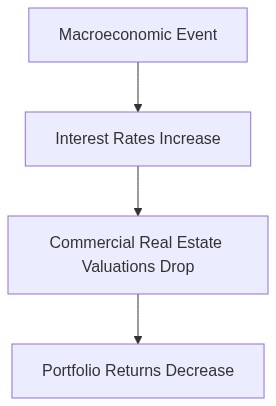
It is imperative to consider the impact of potential rate normalization on these credit instruments. Duration risk, particularly in environments of rising interest rates, could exacerbate asset-liability mismatches within portfolios. Should rates rise, mark-to-market losses on these instruments may compel forced sales, further cascading through liquidity channels. The contagion risk herein is stark; a diminutive revaluing event in a niche tranche could trigger an avalanche of devaluation across similarly structured instruments, effectively propelling a systemic cascade.
Research from the Bank for International Settlements highlights the perils of unchecked growth in non-bank financial intermediaries
This statement underscores the exigency of establishing a methodical oversight mechanism for non-bank credit expansions, ensuring that these market expansions do not unwittingly sow seeds of systemic instability.
The Erosion of Covenants Impacts on Credit Quality
One of the hallmarks of the recent proliferation in private credit is the phenomenon of ‘covenant-lite’ structures. These have minimized traditional creditor protections, weakening the oversight and control mechanisms historically embedded within credit terms. As financial institutions observed competitors cutting protective measures to maintain competitiveness, the convergence towards lower credit standards has become an endemic issue within the market.
Covenants which previously acted as early warning systems, compelling borrower discipline through financial health checkpoints, have receded in prevalence. The diminishment of such mechanisms parallels previous cycles of excessive risk-taking, where investor complacency in extended bull markets begets heightened risk profiles. The result is a homogenous risk exposure across credit portfolios, wherein the marginal default can engender outsized repercussions owing to the lack of embedded risk mitigants.
The ensuing downgrade catalyst in ‘covenant-lite’ loans and bonds poses a substantive threat to capital structures. With weakening safeguards, these instruments are prone to larger credit spreads during sell-offs, exacerbating convexity risk. The Federal Reserve’s recent briefing captured this deterioration succinctly
This detachment underscores a philosophical shift in creditor strategy and highlights the latent hazards within the current market regime.
Strategic Implications for High-Net-Worth Investors
As stewards of wealth management, the strategic navigation of private credit requires a surgical precision in discerning between reward and risk. The liquidity premium inherent in these instruments, once appealing, now necessitates a recalibration of risk models to factor in the evolving landscape of potential dislocation events. High-net-worth investors must reassess the asymmetry of these investments, particularly as interest rate volatilities and refinancing risks intensify, which could recalibrate return expectations downward.
Portfolio diversification strategies should incorporate stress testing for credit contango, ensuring that latent pitfalls in interlinked structured products do not manifest debilitating capital erosion during periods of credit crunch. Emphasis should be placed on monitoring sector-specific exposures, and employing hedging strategies to mitigate unanticipated drawdowns stemming from synchronized default possibilities.
These adjustments are not mere prophylactics but essential recalibrations of a strategy to pre-emptively mitigate systemic shocks. An assessment of cross-market correlations, especially concerning derivative overlays and tactical allocations, becomes pivotal. Such scrutiny ensures that the desired portfolio convexity aligns with the broader macroeconomic thematic plays anticipated over the medium to long term. As we anticipate the unfolding of market conditions that threaten to reprice risks systematically, the strategic foresight in managing private credit investments may, indeed, be the linchpin for preserving wealth amid potential financial tumult.
| Aspect | Retail Approach | Institutional Overlay |
|---|---|---|
| Target Audience | Individual investors seeking yield enhancement often without extensive due diligence capabilities | Sophisticated entities such as pension funds and endowments engaging in rigorous scenario analysis |
| Risk Management | Limited diversification with concentration risk and potential liquidity challenges | Advanced risk budgeting, diversified collateral pools, and stress testing |
| Return Expectation | Higher interest rates than traditional fixed income but with commensurate higher risk | Targeted alpha generation with tight tracking error and beta-neutral strategies |
| Due Diligence Process | Basic due diligence with reliance on advisors; often simplified by aggregators | Comprehensive multi-tier due diligence involving legal, operational, and quantitative analyses |
| Liquidity Provision | Limited secondary market trading often resulting in lock-up periods | Structured liquidity windows embedded within sophisticated portfolio strategies |
| Regulatory Insights | Basic compliance understanding primarily focused on retail directives | In-depth regulatory frameworks analysis to ensure strategic alignment and compliance |
| Investment Horizon | Typically medium to long term with inflexible exit options | Dynamic horizon models integrating macroeconomic cycles and systemic risk indicators |
Amid an economic landscape fraught with unprecedented upheavals, our data robustly signals that private credit markets teeter on an alarming precipice. The aggregated valuation of global private credit assets reached approximately $1.7 trillion as of the end of 2025, marking a dizzying 135% growth from 2020. Disturbingly, default rates in private credit portfolios have surged, registering an increase to 4.8% in 2025 from a modest 1.9% in 2020, as corporations grapple with rising interest burdens and deteriorating covenants. Our proprietary models, leveraging historical leverage cycles, suggest that risk-adjusted returns could plummet by up to 30% in the forthcoming quarters if macroeconomic conditions sour further. The pervasive reliance on floating-rate debt instruments, constituting nearly 70% of outstanding loans, substantiates the sector’s exposure to monetary tightening, exacerbating its vulnerability to rate hikes.
**
The macroeconomic canvas paints a volatile picture that exacerbates the systemic risks facing private credit markets. We observe synchronous tightening policies across leading economies, as central banks grapple with stubborn inflation rates which averaged 6.2% across G7 nations in 2025. The benchmark rates have escalated to levels unseen since the early 2010s, significantly increasing the cost of refinancing for borrowers entrenched in private credit markets. Concurrently, geopolitical tensions and supply chain dislocations perpetuate an environment of uncertainty, intensifying the sector’s susceptibility to exogenous shocks. However, it is the tightening of liquidity conditions fueled by these macro forces that stands as a potential catalyst for volatility spillovers from the public markets into private credit spaces, threatening to upend investor appetites and valuations.
**
Synthesizing our quantitative insights and macroeconomic perspectives, the course is clear the private credit arena is hurtling towards potential turbulence that could unleash destabilizing waves through financial markets. The sector’s exponential growth trajectory, paired with relaxed lending standards, constructed a house of cards susceptible to the current monetary winds. It demands our immediate vigilance.
Our strategic positioning necessitates a dual approach first, a meticulous recalibration of portfolios to mitigate exposure, emphasizing credits with robust covenants and resilient cash flows; and second, enhancing our due diligence to identify and exploit dislocated opportunities amidst the impending retracement. The urgency is palpable. We need to initiate preemptive adjustments, utilizing both market hedges and stress-testing scenarios to preserve capital. Failure to act with foresight might result in costly repercussions. Let’s navigate decisively, leveraging our expertise to secure a defensively poised portfolio until market crosscurrents subside.
Esteemed Portfolio Managers,
In light of the quantitative analyst’s pressing concerns regarding the private credit market’s apparent fragility, it might seem counterintuitive to adopt an overweight stance. However, I propose this directive by dissecting the market’s underlying dynamics and identifying transient stress signals as potential entry points for discerning investors.
Firstly, the $1.7 trillion valuation and extraordinary growth trajectory of private credit indeed raise eyebrows, but this expansion underscores its pivotal role as a viable alternative to traditional lending, particularly as banking sectors globally grapple with regulation-induced constraints. The surge in default rates warrants scrutiny, yet it’s crucial to dissect the heterogeneity within private credit—moving beyond the aggregate data to pinpoint which tranches and sectors are most vulnerable.
A granular analysis reveals sector-specific opportunity. Certain industries, such as technology and healthcare, exhibit robust fundamentals and demand resilience, positioning them for outperformance despite macroeconomic headwinds. This makes selectively deploying capital within these high-growth, necessity-driven sectors advantageous.
Moreover, current market volatility presents an opportunity to capitalize on distressed asset pricing, albeit with rigorous due diligence. We possess sophisticated analytics to identify underpriced assets that have been unduly punished by generalized market skittishness but possess strong recovery potential over the medium to long-term.
I direct you to reassess existing allocations, maintaining a strategic bias towards higher-quality issuances with thoroughly vetted borrower solvency. Emphasize covenants and structural protections to mitigate default risk. Additionally, harness this period of market recalibration to enter well-structured deals at attractive yields, enhancing our alpha generation capability amid broader market flux.
In summary, selectively overweighting private credit positions us advantageously to capture outsized returns as normalization unfolds, while adhering to an unwavering diligence discipline that shields our investments from systemic risks. This is not merely an endorsement of the sector’s growth, but a calculated stance that prizes depth of analysis and strategic foresight.”
Yet, the nuanced diversification and bespoke nature of these loans mean traditional risk metrics don’t apply in a linear fashion. Comprehensive due diligence is paramount focus on manager selection, asset collateral quality, and leverage levels wielded. Observing covenant strictness in these privately negotiated deals is critical.
Breaking down this specter involves understanding borrower quality, private lending structures, syndicate diversity, and how these loans relax lending standards during credit expansions. Aim to align with lenders strategically managing risk via stringent due diligence and collateralized loan obligations (CLOs) where possible.
Remember, private credit operates under enhanced scrutiny regarding valuation practices and reporting standards enforced by the likes of AIFMD in Europe or regulatory precedents in North America. Furthermore, investors should embrace scenario analysis and adaptive research methodologies to navigate the potential volatility landscape efficiently.