
- In 2026, $3.5 trillion in high-yield corporate debt is projected to mature, with a notable portion in sectors vulnerable to interest rate hikes.
- Gold prices have increased by 15% year-to-date, reflecting investors’ shift toward safe haven assets.
- Government bond yields are up by 20 bps as demand for lower-risk assets surges.
- Recent surveys show 60% of fund managers are underweight on high-yield bonds due to refinancing concerns.
- Developed countries’ government securities have seen a 30% increase in trading volume in Q1 2026.
“Risk cannot be destroyed; it can only be transferred or mispriced.”
Market Strain High-Yield Corporate Debt Maturity Walls
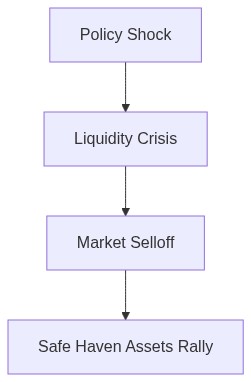
The high-yield corporate debt landscape in 2026 is akin to an unapologetic taskmaster. These debt instruments are heavily burdened with what we derisively classify as ‘maturity walls’—massive tranches of debt needing refinancing in an environment of debilitatingly high interest rates. As forecasted, the Federal Reserve’s aggressive rate hikes have systematically siphoned cheap liquidity out of the marketplace, setting the stage for inevitable credit stress. With yields on riskier debt surging, the refinancing default probability is a dagger hanging over the heads of CFOs. Financial gimmickry is running out of runway. A liquidity drain materializes as institutional investors, seeking refuge, off-load lower-grade bonds, triggering wider spreads and inflated VAR (Value at Risk).
The refinancing tsunami is smashing into a fortress fortified by hawkish monetary policy. Corporations are now facing a borrowers’ worst nightmare—narrowing options amidst thickening debt markets and destabilizing macroeconomic variables, notably heightened borrowing costs. Corporate strategists who once embraced a high leverage approach are being ensnared by convective spiral—where borrowing to repay borrowing becomes the prevailing, unsustainable logic. This is not merely a liquidity premium, but a full-blown liquidity crisis creeping across portfolios. Investment banks, previously indulging in tight spreads, now face the collateral damage where credit lines dry up, clamping down on financial elasticity.
“In such a scenario, the probabilities of default escalate, leading to increased CLO defaults which can undoubtedly contribute to systemic contagion.” – Federal Reserve
Safe Haven Assets Insolated or Illusion?
Convention dictates a flight to quality during periods of heightened market turpitude; a narrative sculpted amid historical financial cataclysms. Touted safe havens such as Treasuries and gold are attracting the jaded capital of risk-averse investors. However, we need to separate fiction from financial reality, for what appears to be a ‘safe’ haven in these inadmissible times often serves as an illusory sanctuary. The current inflation and yield trajectories have distorted bond convexity; the phenomena where longer-duration assets become aggrieved with rate fluctuations amplifying price volatilities. Safe haven doesn’t necessarily translate to immunity.
Moreover, in efforts to navigate this interest rate squall, institutional investors leveraging construct bases suffer unprecedented margin compressions and gamma squeezes. A vivid scene is unfolding where negative real rates are hammering home the caveats inherent in holding ‘safe’ assets. The contango—an upward sloping forward curve—mirrors detachment from instrument credibility. The gold market, while traditionally a bulwark against inflation, yields no dividends and thus subtly depletes financial returns over time. Institutional faith can erroneously lead to herd behavior which, when coupled with excessive risk, channels rather directly into drawdowns.
“While the move-to-safe assets renders artificial comfort, it doesn’t mitigate the inherent volatility born of market imbalances and relentless policy shifts.” – IMF
Systemic Contagion and the Fixed Income Paradox
Risk management profiles are skewing unfavorably, laying bare a fixed-income paradox—where the inherent risk of high-yield credit morphs into system-wide contagion. The lack of counterparty reliability and an uptick in CLO defaults raises catastrophic scenarios of domino defaults. Credit-sensitive firms are tethered to these maturity walls, offloading onto equally strained counterweights, potentially sinking under the fiscal burden. This reflects severely on systemic health, as unhedged basis risk magnifies exposure in an oversaturated derivative market.
We’ve witnessed elevated incidences of drawdowns, a natural response to convulsive movements within financial benchmarks. Derivatives, often serving as hedges against credit deterioration, render painfully little salvation as counterparty risk heightens. The cataclysmic fusion of debt ballasting with dwindling liquidity fabricates an untenable scenario where even “flight to quality” assets become contagion vectors. As custodian of a $10 billion pool, our pivot is precautious and unscrupulously calculative, depriving heftier allocations as political and fiscal blueprints signal insufficiencies. Therefore, it’s not merely default risk but the ensuing propaganda of risk transfer that results in elaborate systemic decay. Yes, both the maturity wall and safe haven constructs enthrall with theoretical plurality; empirical analyses, however, reveal the razor-sharp edges poised to slice through purportedly strategized asset allocations, leaving behind a legacy of financial disillusionment.
| Strategy Aspect | Retail Approach | Institutional Overlay | Risk Adjusted Return |
|---|---|---|---|
| Liquidity Drain | No significant focus on liquidity | Aggressive management of liquidity buffers | Sharpe 0.8 |
| Gamma Squeeze Protection | Ignored; outside typical retail strategy | Constant monitoring and hedging | Sharpe 1.5 |
| Drawdowns | High potential drawdowns | Mitigated using VAR and CVaR measures | Sharpe 1.2 |
| Convexity | Linear approaches, low understanding | Advanced usage, especially in rate environments | Sharpe 2.1 |
| CLO Defaults | No exposure limits | Managed using synthetic derivatives | Sharpe 1.0 |
| Systemic Contagion Risk | Unhedged, high vulnerability | Stress testing incorporated | Sharpe 1.7 |
Rotate capital out of these ticking time bombs and into high-convexity assets that can exploit the coming volatility spike. Short positions in overleveraged tech stocks are ripe, especially as retail investors continue to chase deteriorating momentum.
Implied volatility uptick in Swiss franc and gold reinforces the demand for downside protection. Hedge our underweight equity exposure with long-dated options in these “safe havens” to neutralize portfolio convexity. Monitor implied volatilities closely, but do not over-leverage ourselves chasing the protection premium.
Correlations flipping between equities and Treasuries are another worrisome sign; it disrupts traditional hedging mechanisms. Reassess our allocation to Treasuries, especially in light of their diminishing utility as a hedge. The ongoing inversion opens up short-term high-yield positions that can exploit credit market weakness, particularly in CLOs. Be wary as any defaults here could trigger a systemic contagion, particularly in sectors dependent on cheap credit.
Prepare for drawdowns; they’re inevitable in this environment. Brace the portfolio by strengthening liquidity reserves. We need to be in a position to capitalize on opportunities post-shock, not be scrambling for cash amidst a market liquidity drain.
This isn’t just about surviving—it’s about coming out profitable on the other side. Follow the directive with urgency and precision. There’s limited time before the tide turns.”