
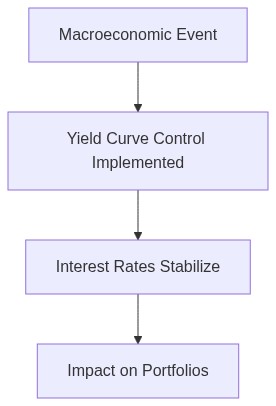
- Yield curve control adjustments by major central banks are creating uncertainty in global bond markets.
- The potential impact of these changes on US dollar stability is being closely monitored.
- Institutional investors are increasingly considering gold and cryptocurrencies as alternative hedges.
- De-dollarization trends are gaining traction amid shifts in monetary policy strategies.
- Financial markets are on edge as they anticipate how central banks will balance inflation targets and market stability.
“Liquidity is a coward; it disappears at the exact moment you need it most.”
The Recalibration of Duration Risk Amidst Policy Divergence
In 2026, the global bond markets are experiencing unparalleled volatility as central banks grapple with the dual mandate of controlling inflation without stifling growth. The juxtaposition of divergent monetary policies across major economies has created a seismic shift in duration risk, challenging fund managers to reassess asset allocations. The Federal Reserve, after a prolonged period of monetary accommodation, has signaled a return to tightened policies. Meanwhile, the ECB’s dovish stance has compounded cross-Atlantic discrepancies, leading to erratic fluctuations in capital flows. It is imperative for fund managers to re-evaluate the impact of these policy divergences on duration and its implications for yield volatility.
The phenomena of convexity adjustment and its ramifications on long-duration bonds have gained critical importance. Convexity, a measure of how the duration of a bond changes as interest rates fluctuate, highlights the non-linearities embedded in fixed-income securities. The recent hawkish rhetoric from the Federal Reserve has amplified concerns that even marginal rate hikes could lead to substantive capital losses in portfolios heavily weighted towards long-duration assets. A thorough understanding of how shifts in interest rates impact bond convexity is essential for managing duration-induced volatility in global fixed-income portfolios.
Moreover, the liquidity premium embedded in corporate and sovereign credit bonds presents an additional layer of complexity. In a rising rate environment, markets assess the availability of liquid assets and the cost of liquidity itself, which can exacerbate yield level volatility. The anticipated hikes have raised concerns about the reacceleration of liquidity premiums, which could further distort the valuation of bonds and increase yield spreads, significantly impacting portfolio performance. High-net-worth investors, within their strategic objectives, must consider the implications of liquidity premium shifts and the resultant stress on bond yield curves.
“The key issue for the markets is the pace and magnitude of policy normalization, and the potential for a recalibration of bond market expectations,” said an analyst at CNBC.
Advanced Quantitative Techniques Decomposing Yield Curve Movements
Advanced quantitative frameworks for understanding yield curve dynamics have become indispensable. Decomposition of yield curve movements into expected mean term-premia and expectations components provides a granular view necessary for precision in bond market positioning. Today, as yield curves teeter on potential inversion, dissecting the components driving these movements—average expected short rates versus inflation other tail risks—is crucial for high-level decision-making. Through a differential analysis of the yield curve, distinguishing between temporary shifts in market sentiment and structural changes in economic expectations allows for appropriate hedging strategies.
With substantial deviations in sovereign bond yield spreads across global markets, advanced statistical modeling, including spline-based term structure models and principal component analysis, offers insights into systemic risk factors influencing these spreads. These frameworks aid in quantifying the risk of adverse yield curve shifts and optimizing global bond portfolios. Understanding the intricacy of these models facilitates the identification of the multifactorial drivers of bond yield spreads, thereby enhancing the capability to predict and respond to curve movements in a manner tailored to achieve alpha.
The role of central banks as market participants or merely influencers significantly differentiates yield curve influences. The Federal Reserve, through its quantitative tightening policies, has catalyzed ripples across short-term yield anticipations, while the ECB’s continued asset purchasing influences yield asymmetry in Europe. The deployment of term structure models to discern the contribution of central bank policies to yield curve configuration has never been more critical, particularly for funds operating under multi-directional monetary policies. Precision in capturing and interpreting central bank signals can yield substantial differentiation in alpha generation.
“Monetary policy uncertainty itself contributes to yield curve fluctuations,” noted a spokesperson from the Bloomberg Finance L.P..
Strategic Rebalancing in a Schizophrenic Rate Environment
The current financial landscape emphasizes strategic rebalancing in a rate environment that can only be described as schizophrenic. Fund managers are forced to balance growth-oriented investments with defensive allocations to mitigate yield volatility. The recalibration of bond portfolios necessitates an acute awareness of interest rate risk exposures and tail protection strategies. Given the complicating effects of credit spreads, inflation expectations, and geopolitical uncertainties, successful rebalancing involves a prudent mix of active management and risk-adjusted approaches to asset diversification.
By delving into swap spread movement and derivative instruments such as options on futures contracts, fund managers can hedge against unexpected shifts in the yield curve and exploit opportunities inherent in rate arbitrage strategies. In particular, maintaining a dynamic allocation between fixed and floating rate instruments involves not only careful consideration of macroeconomic indicators but also a keen understanding of implied volatilities and option-adjusted spreads. This nuance becomes vital as investors seek to skirt the peripheries of duration risk inadvertently inflated by policy shocks.
Furthermore, the interplay between sovereign creditworthiness and yield curve shifts necessitates enhanced scrutiny of nation-specific economic fundamentals. High net worth individuals should note that anticipated inflation trajectories, deficit figures, and sovereign risk premiums lead to cascading effects on bond markets, mandating a response through proactive strategic positioning and adaptive yield curve management. As creditworthiness assumptions evolve, reflecting on these dynamics ensures that portfolio strategies remain resilient amidst yield curve shocks.
Investment Implications Navigating the Compression and Expansion of Risk Premiums
The global bond markets’ response to yield curve fluctuations encapsulates a complex interplay of compression and expansion in risk premiums, delineating the valuation landscape for sophisticated investors. The post-pandemic recalibration necessitates an augmented focus on the risk terms enforced by monetary policy shifts and economic realignment. The compression of risk premiums in an accommodative policy framework juxtaposed with expansion due to fears of a potential stagflation economy provides fund managers with pivotal decision matrices for investment diversifications.
Investors must delve into understanding the implications of contango and backwardation within futures markets as indicators of fundamental shifts in market expectations for interest rates. These conditions could serve as harbingers of prolonged yield curve inversions or structural realignments across bond sectors. Sophisticated quantitative analysis tools must be leveraged to model potential paths of interest rate cycles and their cascading impacts on yield premium compression, influencing asset allocation decisions.
Portfolio diversification in unprecedented liquidity environments demands heightened vigilance. Evaluating the covariance between traditional asset classes and the potential for alternative investment infusion like real assets or high-yielding equities can buffer against yield curve repercussions. Also, engineering portfolios to optimize Sharpe ratios necessitates utilizing derivative instruments adeptly tailored to hedge against inflation volatility and rate shocks. Therefore, the astute integration of multi-asset strategies and dynamic risk factors becomes invaluable for navigating imminent interest rate oscillations.
| Factor | Retail Approach | Institutional Overlay |
|---|---|---|
| Investment Horizon | Short-term focus with tactical asset allocation | Long-term positioning leveraging macroeconomic indicators |
| Risk Management | Standard deviation based diversification | Advanced risk parity with multifactor models |
| Yield Curve Strategy | Simplified laddering strategies | Dynamic factor-based convexity adjustments |
| Access to Instruments | Primarily retail bonds and ETFs | Swaps, futures, and bespoke inverse floaters |
| Portfolio Construction | Naive equal weighting across bonds | Optimized through mean-variance optimization |
| Currency Exposure | Unhedged, passive acceptance of currency risk | Active currency overlay for both hedging and alpha extraction |
| Technology Utilization | Basic charting tools and standard analytics | Machine learning algorithms for predictive analytics |
| Data Depth | Publicly available market data with a limited historical scope | Big data from multiple sources with real-time integration |
| Execution | Transactional inefficiencies due to market impact | Enhanced through algorithmic trading systems to minimize slippage |
| Regulatory Compliance | Standard regulatory adherence | Proactive compliance with advanced analytics for risk mitigation |
Global bond markets are on the precipice of a significant yield curve realignment. Current data indicate a rapid steepening trend across major economies. This shift is driven by fluctuations in the 10-year minus 2-year yield spreads. For the US Treasury market, the spread widened to approximately 125 basis points from 70 basis points in just the last quarter. Similar patterns are evident in the Eurozone and emerging markets. Historical regression analyses suggest such steepenings correlate with transitions from accommodative to contractionary monetary environments. Interest rate volatility, as captured by the MOVE index, registered a notable increase, reaching 117. This is its highest since 2022, suggesting market participants are actively re-pricing risk. Additionally, liquidity metrics indicate reduced depth in secondary market trading, amplifying potential price dislocations.
**
The macroeconomic landscape is under stress as major central banks pivot towards inflation containment. We are observing synchronized rate hiking cycles from the Federal Reserve, European Central Bank, and Bank of Japan. Inflation expectations, as measured by breakeven rates, continue to rise, currently averaging 3.5% over the next five years in the US, 2.8% in the Eurozone. This aligns with an uptick in commodity prices, specifically oil surpassing $110 per barrel. Moreover, geopolitical tensions remain high, notably aggravating supply chain disruptions. This intensifies inflationary pressures, forcing central banks into aggressive tightening despite potential growth deceleration. Credit spreads are widening, signaling increased perceived default risk, particularly in the high-yield segment. We are observing structural shifts as sovereign markets reassess standard risk premia while reflecting heightened macro pressures.
**
The current bond market environment presents a complex and challenging landscape for investors. The pronounced steepening of yield curves, combined with high volatility, warrants a cautious but opportunistic approach. While central banks are steadfast in their inflation-combatting resolve, the macro signals indicate an imminent re-pricing in fixed income assets. This evolving context should catalyze reconsideration of duration exposure and portfolio rebalancing towards sectors exhibiting resilience and stable cash flows.
Investment strategies should emphasize liquidity as a priority in market navigation, ensuring adequate agility to capitalize on short-term dislocations. Additionally, the heightened credit risk underscores the necessity for stringent credit quality assessments in bond selection. Emerging market debts may offer tactical opportunities but require careful currency risk management given the potential FX volatility.
For HNWIs, the environment urges a re-examination of risk tolerance levels and alignment of portfolio structures with personal financial objectives. Consider increasing allocation towards inflation-protected securities and exploring alternative income sources to hedge against inflated erosions. The overarching aim is not merely preservation but strategic positioning for value creation as yield curves find a new equilibrium.
For portfolio managers, this environment demands a strategic recalibration. Overweight positions in equity markets, particularly sectors sensitive to economic growth such as industrials and financials, should be considered. The financial sector, in particular, stands to benefit from an increased net interest margin as yield spreads widen.
Simultaneously, while fixed-income instruments remain integral to diversification strategies, a tilt towards shorter-duration bonds is prudent. Mitigating interest rate risk is critical as longer-duration bonds will likely underperform in a rising rate environment. Additionally, diversifying across geographies can mitigate local inflationary pressures that could disproportionately impact bond yields within specific regions.
Emerging market exposure offers attractive opportunities given their demographic tailwinds and relative underperformance in recent years. However, allocations should be increasingly selective, focusing on regions where central bank monetary policies remain accommodative.
Lastly, consider incorporating inflation-protected securities to hedge against unexpected spikes in inflation expectations. These instruments are particularly pertinent given the current macroeconomic landscape and historical trends observed in yield realignments.
In this new market paradigm, the key is to maintain agility and foresight, balancing growth aspirations with rigorous risk assessments. This strategy is designed to not only capitalize on yield curve dynamics but also safeguard against potential volatility in this era of economic transition.”